
Wound Care News: Medicare Will NOT Pay for CTP/Skin Substitute Wastage “Under Any Circumstances”
CMS clarifies use for skin substitutes in 2026, confirming discarded or excess incident-to supplies are not payable and tightening graft billing rules.
admin
1/8/20263 min read
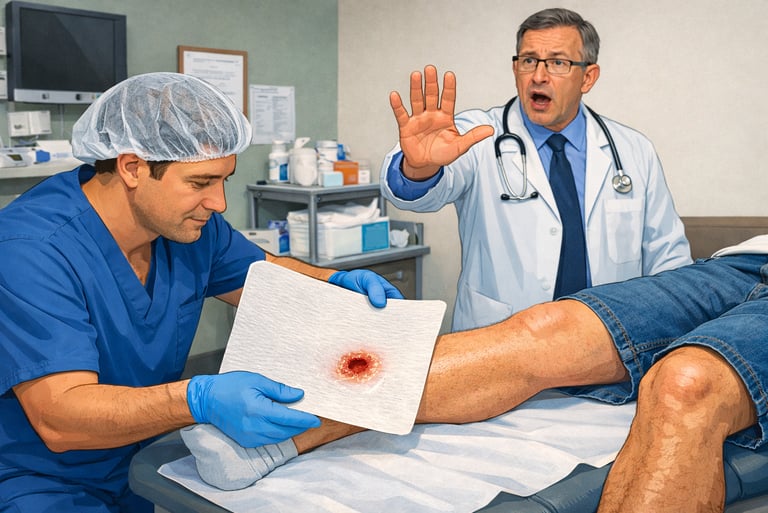
The Centers for Medicare & Medicaid Services has updated its FAQs on the JW and JZ modifiers. These FAQs clearly state that Medicare fee for service (FFS) does not pay for discarded amounts of “incident to supplies” (which is how all non-BLA CTPs/skin subs are now classified) and will only pay for the amount of product furnished.
"Q9. Should the JW and JZ modifiers be used when billing for separately payable incident-to supplies?
A9. The JW and JZ modifiers are only used when billing for drugs and biologicals separately payable under Medicare Part B as described in FAQ 8. The JW and JZ modifiers are not appropriate for billing for incident-to supplies, even if such incident-to supplies are separately payable. In addition, discarded amounts of incident-to supplies are not payable by Medicare.
In the CY 2026 Physician Fee Schedule (PFS) final rule0 and CY 2026 OPPS/ASC final rule with comment period, CMS finalized to pay separately for the provision of certain skin substitutes (hereinafter referred to as non-BLA skin substitutes) as incident-to supplies under the PFS in the nonfacility setting, and under the OPPS/ASC in the facility setting, beginning January 1, 2026 (90 FR 49492; 90 FR 53748). As a result, non-BLA skin substitutes are no longer payable under Medicare Part B as a drug or biological as of January 1, 2026, and only the administered portion is payable.
For dates of service starting January 1, 2026:
If a provider or supplier administers an entire non-BLA skin substitute from the package or container (and no units are discarded), the JZ modifier is not appropriate when billing Medicare.
If a provider or supplier administers a portion of a non-BLA skin substitute from the package or container and a portion is discarded, the provider or supplier may only bill for the units that are administered. It is not appropriate to bill Medicare for such discarded units under any circumstance (that is, such units may not be billed with the JW modifier and such units may not be included when billing for the administered amount)."
Probably as a result of rumors of manufacturers only providing large sized grafts so that their margins don't fall off a cliff, CMS has nipped this potential loophole in the bud so that providers aren't putting a 10X10 cm graft on a 4 sq cm wound and seeking reimbursement for the full size graft.
This clarification makes sense as long as the correct definition of “administered” is used. To properly apply a skin sub or STSG, there must be an overlapping edge. A standard fixation/overlap edge for grafting is 0.5-1 cm for most wounds. So from a graft sizing point of view, adding 0.5-1 cm to the edge of both the length and width of a wound’s entire perimeter ensures appropriate “administration” and minimizes “discarded” waste. As long as a provider documents that the graft was administered with “fixation edges included”, the use of the above formula should be very defensible in case of a chart is audited later. The key to the new guidance is, providers will not be rewarded for ordering huge grafts and applying them to tiny wounds.
Our Commitment to Maximizing Healing & Reimbursement
At Wound Care Portal, we work with advanced wound care products designed to support both clinical outcomes and reimbursement success in an increasingly evidence-driven environment.
If you want to:
Navigate the new LCD landscape with confidence
Optimize healing outcomes for DFU and VLU patients
Protect your clinic from reimbursement disruptions
We’d be happy to help.
📞 Schedule a 15-minute discovery call to discuss wound care solutions that align with CMS coverage standards and support long-term practice sustainability.
👉 Contact us today to get started by going to our Contact page, emailing us at admin@regenedgesummit.com, or calling us at (203) 715-8390.